Concrete & screed calculator
Enter the length, width and depth of the pour and choose the mix. The calculator returns the volume in cubic metres, the number of 25 kg cement bags, and the sand and aggregate in tonnes — with a waste allowance so you don't run short at 4pm on a Friday.
Dimensions
Pricing the job? Open EstiMate free and these quantities go straight onto the materials list with your prices.
How it works out the quantities
- 1Volume = length × width × depth, in metres, giving m³. Round pads and strip footings can be added as separate pours and summed.
- 2Each mix has a cement, sand and aggregate weight per m³ (for example C25 uses about 320 kg cement, 600 kg sand and 1,100 kg aggregate per m³).
- 3Bag count = total cement ÷ 25 kg, rounded up. Sand and aggregate are shown in tonnes so you can order bulk bags or loose loads.
- 4A waste allowance (typically 5–10%) covers over-dig, uneven formation and spillage.
Site tips before you order
- C20 for paths, shed bases and non-structural slabs; C25 for footings, oversite and garage floors; C30 for driveways, structural slabs and anything a vehicle drives on.
- Over about 2–3 m³ it's usually cheaper and quicker to order ready-mix than to hand-mix — use the m³ figure to get a price.
- Strip footings are rarely dug perfectly: allow 10% or more waste on trench pours.
- Screed is a 1:4 sand-and-cement mix with no aggregate; the calculator switches the recipe when you pick it.
Common questions
Can I use the concrete calculator on site?
Yes. It runs in your phone's browser with nothing to install, so you can measure the pour on site, enter length, width and depth, and get the m³, cement bags, sand and aggregate before you ring the merchant or the ready-mix supplier.
How much concrete do I need for a 3 m × 3 m shed base at 100 mm?
3 × 3 × 0.1 = 0.9 m³. With 10% waste that's about 1 m³ — roughly 13 bags of cement, 0.6 t sand and 1.1 t aggregate for C20, or one small ready-mix load.
How many 25 kg cement bags per cubic metre?
It depends on the mix: about 11–12 bags for C20, 13 for C25 and 14–15 for C30 when batching by weight. The calculator does the rounding.
What's the difference between C20, C25 and C30?
The number is the compressive strength in N/mm² at 28 days. Higher grades use more cement per m³ and are used where loads are higher — driveways, structural slabs and foundations in poorer ground.
Can I put these quantities straight into a quote?
Yes — EstiMate is free to start; the same calculators live inside the app and the quantities go onto the materials list with your prices.
Related calculators
Brickwork & blockwork calculator
Give the wall length and height (or the area), pick brick or block and the bond, and get the number of units, …
Sand & cement mortar calculator
Pick the ratio and tell it the wall area or the mortar volume you need. It returns 25 kg cement bags and sand …
Screeding calculator
Enter the floor area and screed depth, choose the type, and get the volume plus cement bags and sand (or produ…
From a quantity to a priced line
The calculator gives you the quantity. In EstiMate that quantity becomes a priced line on the quote, with the working printed underneath so the client can see where the number came from, as on this page from a sample quote.
You choose what the client sees. Show or hide the materials and labour breakdowns, and add your markup so the client sees your selling prices. Your true costs and your margin stay inside the app, for you only.
See the full sample quote →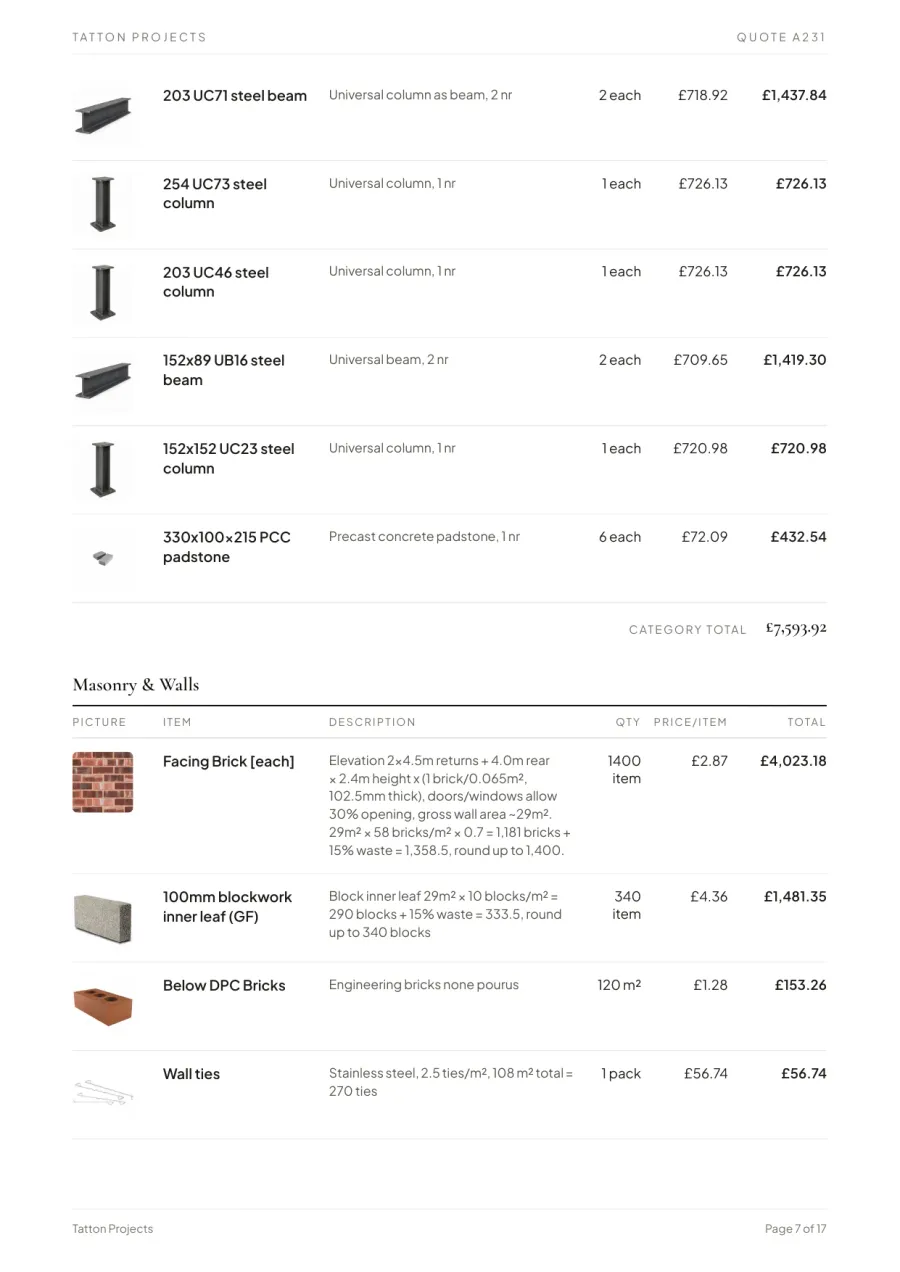
Quantities are half the quote. EstiMate does the other half.
Drop the numbers into a priced, branded quote your client can accept online — free for your first three jobs a month.
Try EstiMate freeNo credit card · Free plan always available · Cancel anytime
Rather be shown round first? Book a live demo