How do you make a payment application under the Construction Act?
By Dave Groom·AI-assisted·Editorial policy
A payment application is your written notice of the sum you consider due at a payment due date and how you worked it out. Under the Construction Act, most construction contracts lasting 45 days or more carry a right to stage payments. If the payer sends no valid notice in time, your application can become the sum they must pay.
The Act is the Housing Grants, Construction and Regeneration Act 1996, Part II, as amended in 2011. The Scheme for Construction Contracts fills any gaps your contract leaves.
Does the Construction Act apply to my job?
It applies to construction contracts between businesses: a main contractor and its subcontractor, or a builder and a commercial client. Section 106 excludes contracts with a residential occupier, meaning work mainly on a house or flat that the client lives in or plans to live in.
So for a homeowner extension, the payment terms come from your own contract. For a subcontract on that same extension, the Act applies.
When are you entitled to interim payments?
Section 109 gives a right to instalments, stage payments or other periodic payments unless the contract says the work will take less than 45 days, or the parties agree it's estimated to take less than 45 days.
You and the payer are free to agree the amounts and intervals. If you don't agree them, the Scheme applies.
What must a payment application include?
Section 110A says a payee's notice must specify two things:
- the sum you consider due, or to have been due, at the payment due date
- the basis on which that sum is calculated
The Act says the sum can be zero. In practice, set it out so the other side can check it line by line: the contract sum, work done to date, agreed variations, any retention, and what has already been paid.
What does "the basis of calculation" look like?
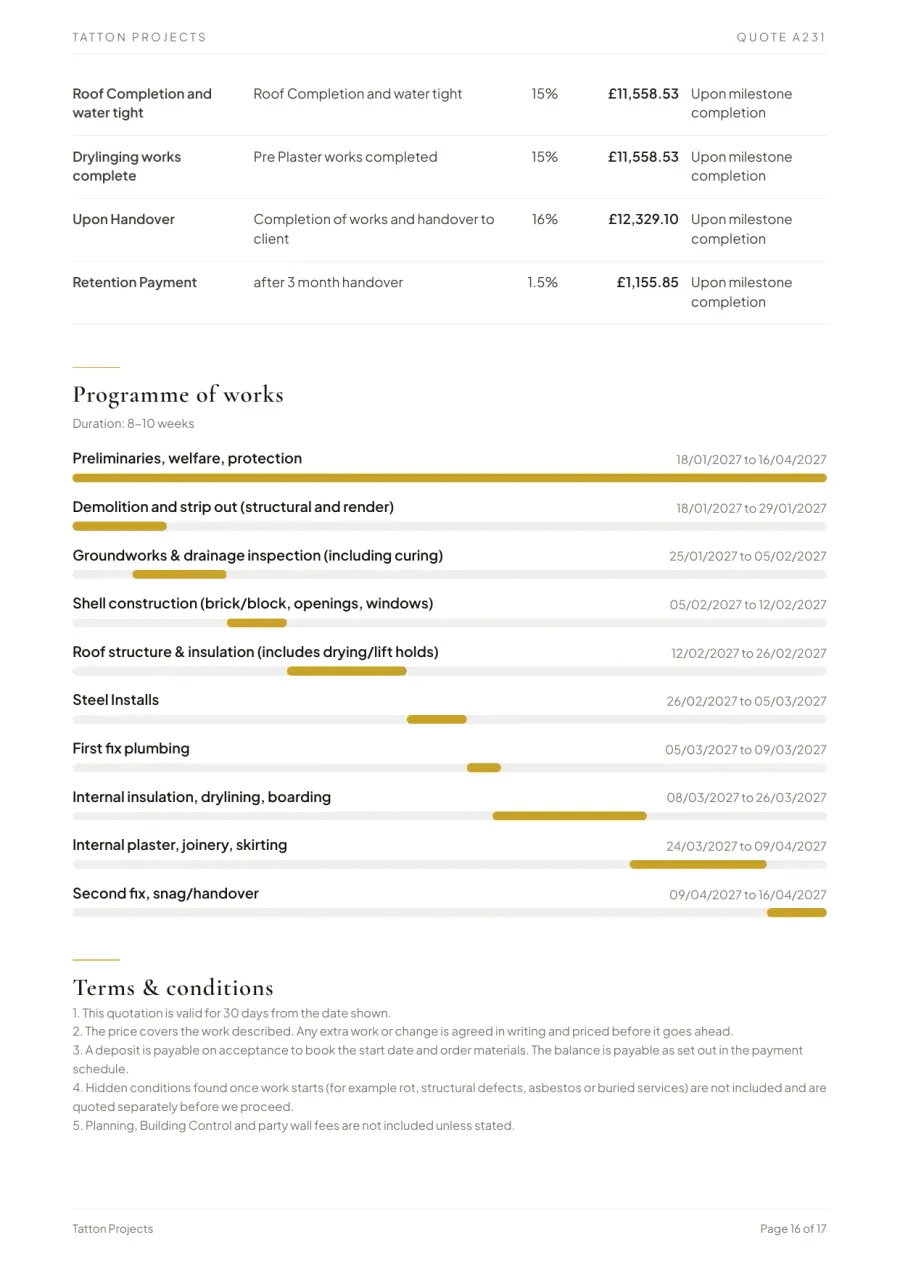
A short schedule is enough. List each package or stage with its value, the percentage complete and the amount claimed. Then show variations separately, each with its instruction reference, and deduct previous payments.
The clearer the basis, the harder it is to argue that your notice isn't valid.
When are payments due if the contract says nothing?
If the contract has no adequate mechanism, the Scheme sets the timetable:
- the relevant period is 28 days, unless the contract gives another
- each payment is due 7 days after the end of the period, or when you make your claim, whichever is later
- the final date for payment is 17 days after the due date
- the final payment is due 30 days after completion, or when you make your claim, whichever is later
What happens if the payer doesn't send a payment notice?
The contract must require either the payer to give a notice within 5 days after the due date, or you to give one. Many subcontracts require the payer to do it.
If the payer misses theirs, section 110B lets you give your own notice. The final date for payment then moves back by the number of days your notice was late. If your contract treats your application as that notice, you don't need to send another.
What is a pay less notice?
Section 111 says the payer must pay the notified sum by the final date for payment. To pay less, they must give a pay less notice stating the sum they consider due and how they calculated it.
The deadline is whatever the contract says. If it says nothing, the Scheme sets it at 7 days before the final date for payment. Without a valid pay less notice in time, the notified sum stands.
Can payment depend on the main contractor being paid?
Generally no. Section 113 makes a clause that ties your payment to the payer being paid by someone else ineffective, unless that third party is insolvent.
Section 110 also says the payment mechanism isn't adequate if it makes payment conditional on obligations under another contract being performed. That catches clauses that only pay you once your work is approved under the main contract.
What should you keep with each application?
Keep a dated copy of each application, proof of when and how you sent it, the payer's notices, and the site records that back up your percentages. Photos and a site diary help if the figures are later disputed.
Retention is usually deducted in the application itself; our retention guide covers how it's released. Valuations, retention and subcontracts are part of EstiMate Pro at £39.99 a month (pricing).
Sources and further reading
- Housing Grants, Construction and Regeneration Act 1996, Part II — legislation.gov.uk
- The Scheme for Construction Contracts (England and Wales) Regulations 1998, Schedule — legislation.gov.uk